Does the pose persist?
Is the starting arrangement maintained during the simulation, or does it drift?

From static poses to dynamic behaviour.
Simulation of stability and interaction persistence over time. A docked pose is a single frame; a trajectory shows whether it holds together.
A static structure can't tell a persistent interaction from one that merely looks right in a single frame.
Analytical questions about the simulated system, not guaranteed outcomes.
Is the starting arrangement maintained during the simulation, or does it drift?
Which contacts survive a meaningful fraction of the run.
Per-residue involvement across the trajectory.
Whether it settles into a different binding mode.
Relative behaviour under matched conditions.
The molecular systems we simulate. Drag a model to turn it.
How a bound ligand and its pocket contacts behave through the run.
Enquire about Protein–Ligand simulationsInterface contacts and how consistently they hold.
Enquire about Protein–Protein simulationsCDR loop flexibility and paratope–epitope contacts.
Enquire about Antibody–Antigen simulationsMatched wild-type and variant runs, compared side by side.
Enquire about Mutation / Variant simulationsSampling of energetic states, reported comparatively.
Enquire about Free-Energy simulationsIllustrative MD simulations of each system type, not outputs from an actual run.
The structure is protonated, solvated, and parameterised with a suitable force field.
Minimisation, heating, and density equilibration bring the system to stable conditions.
A GPU-accelerated run at the agreed length and replicate count.
Deviation, flexibility, contacts, and collective motion are quantified.
End-state free-energy estimates, where appropriate, for comparison.
Protocol, results, figures, and limitations in one report.
Measures overall structural deviation relative to a reference structure across the trajectory. It depends on the reference and the atoms selected, and a low value alone does not show a structure is stable.
Check whether a docked pose is maintained and its contacts persist during the simulation. This is consistent with, not proof of, binding.

Characterise Fv–antigen interfaces, CDR contacts, and binding behaviour through the run.
Follow interface stability, residue contacts, and hydrogen-bond networks across the trajectory.
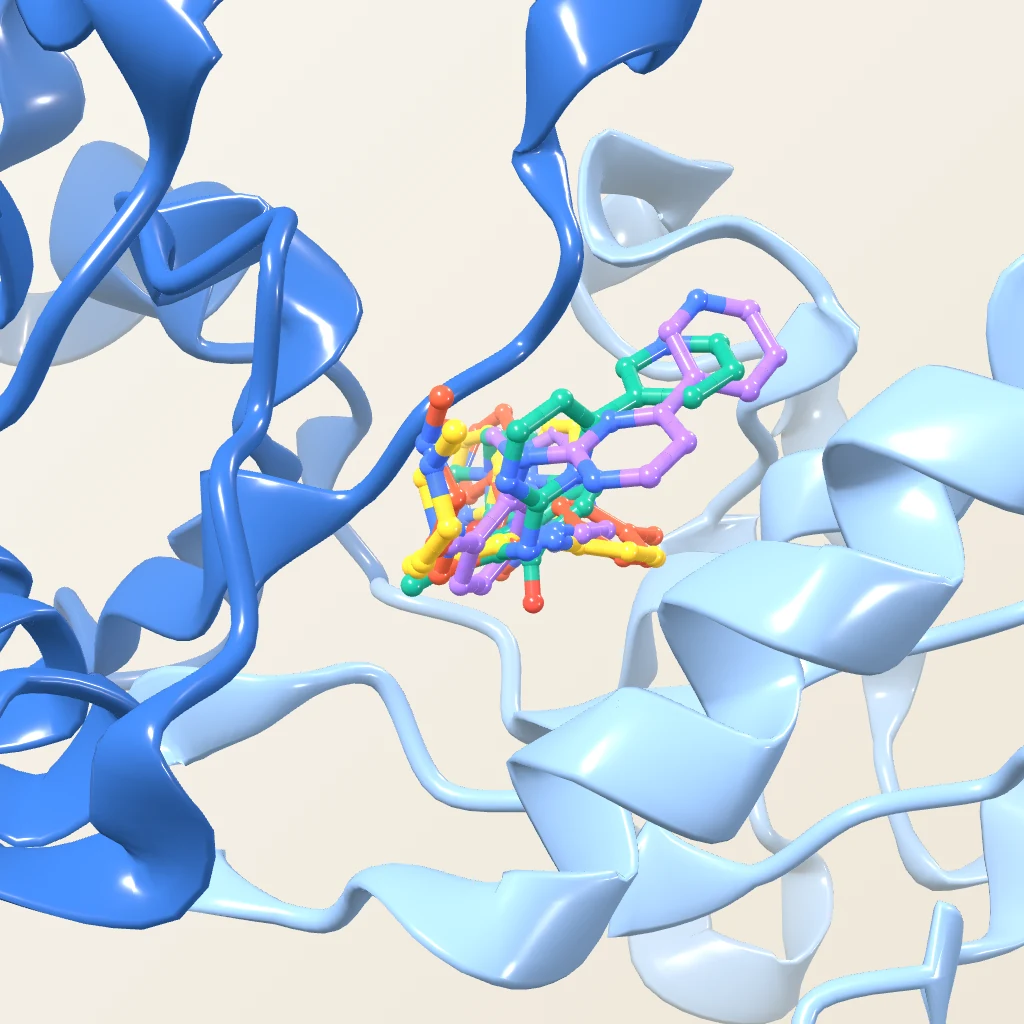
Compare candidates on RMSD, contact persistence and energetic estimates as inputs to experimental selection, not as a ranking of activity.
Evaluate how sequence changes affect stability, flexibility, and binding interfaces.
Approximate binding-energy contributions with MM-PBSA/MM-GBSA and residue-level decomposition. These are end-point approximations, not absolute affinities.
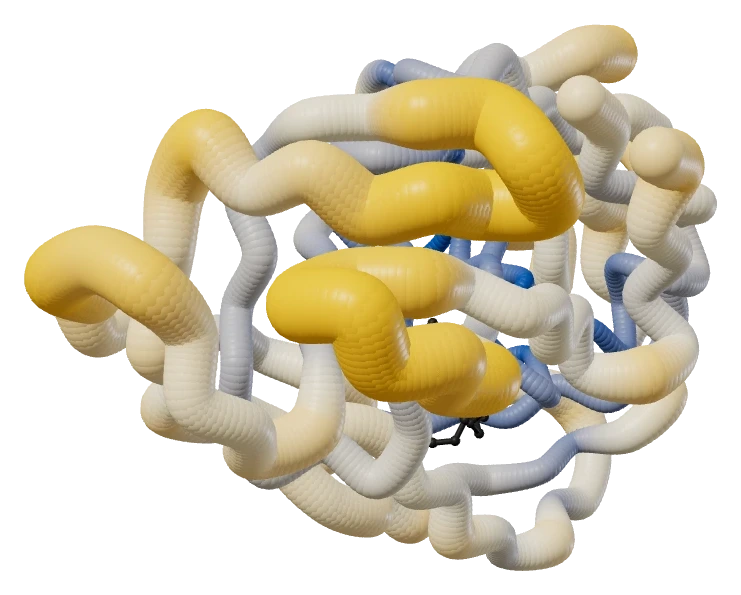
Capture flexibility and conformational states that a single static structure can't show.
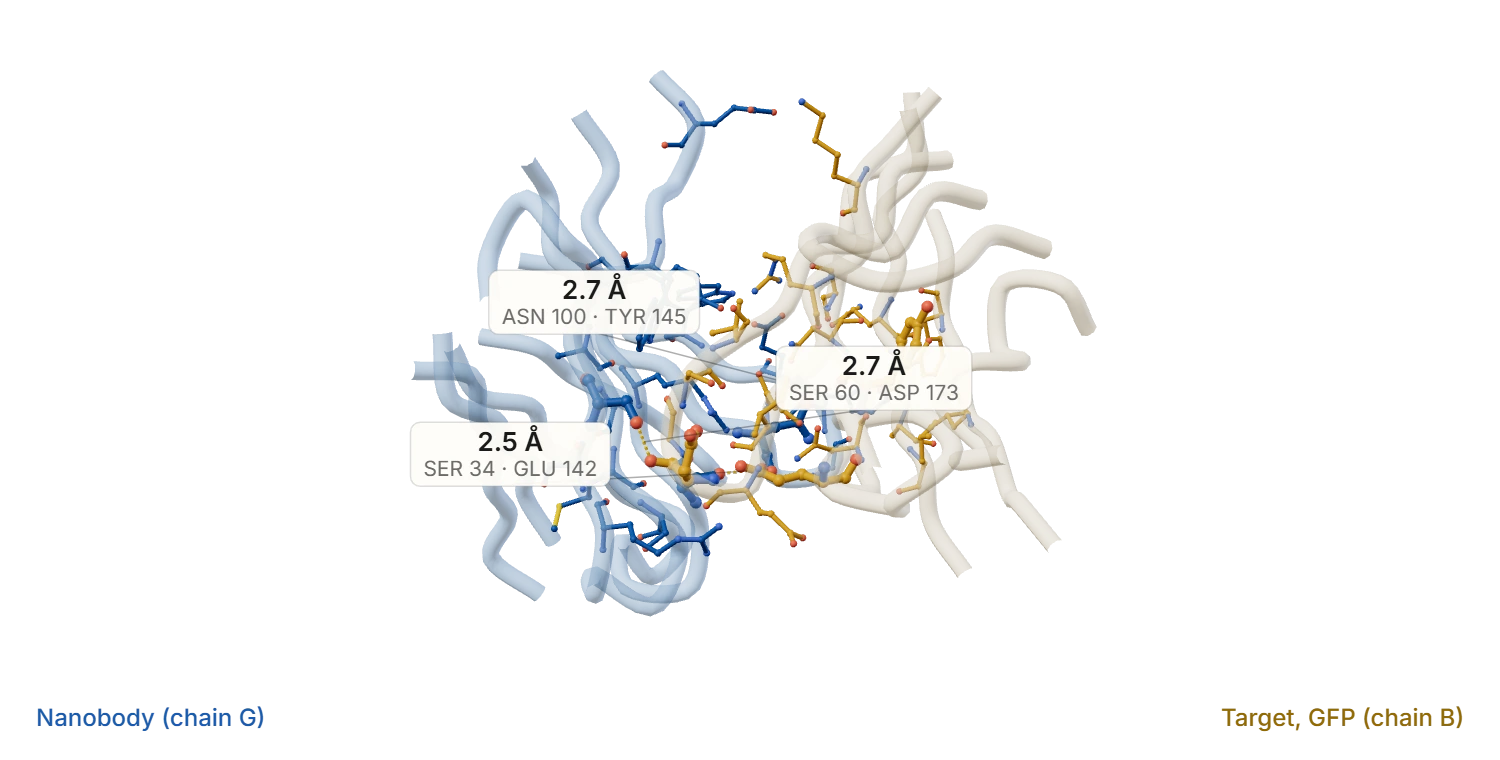
Uncover dynamic interaction networks and conformational transitions behind molecular recognition.

Compare binding modes and dynamic behaviour across a candidate series to guide design.

Assess engineered antibodies and proteins for interface behaviour and stability.
Animated visuals are illustrative MD simulations, not outputs from an actual run.
A crystal or docked structure is one snapshot. Over a trajectory the same protein flexes, rearranges and moves between conformational states, which MD resolves and quantifies.
Custom MD simulations that report flexibility, interaction persistence and conformational behaviour over the simulated time.