
Explore Protein Mutations. Prioritize What to Investigate.
Explore amino-acid substitutions, compare transparent sequence-based scores and shortlist candidate variants for further evaluation. It ranks candidates and does not guarantee improved binding.
- Q3E
- Q3N
- Q3K
Illustrative example sequence. Variants are candidates to evaluate, not predicted improvements.
A bioinformatics platform for antibody sequence characterization and mutation analysis. It identifies substitutions, insertions and deletions across antibody regions, including CDRs and framework regions, and maps them for comparison.
Supporting antibody engineering, optimization, therapeutic development and drug discovery.
- A · Sequence input
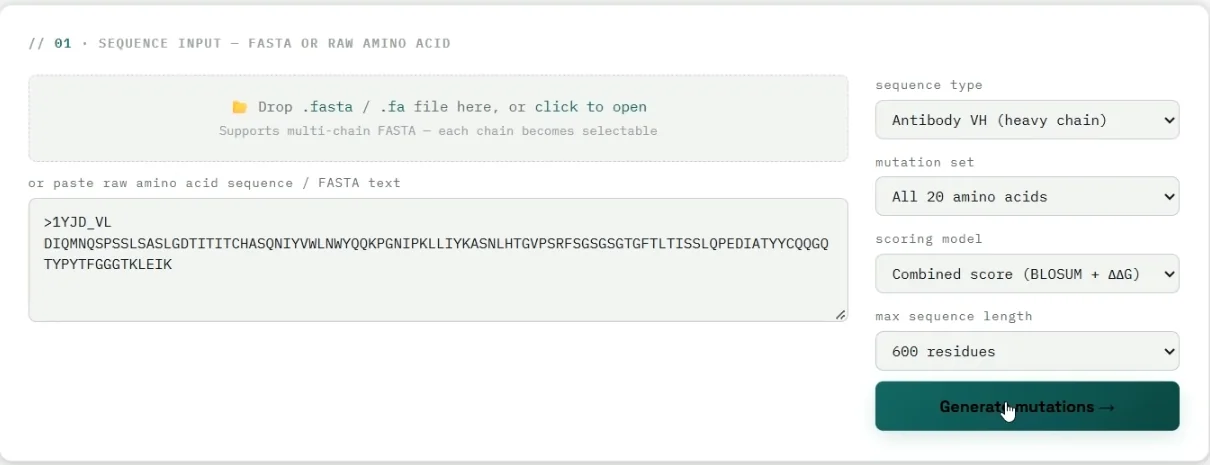
Start with your protein sequence
Drop a FASTA file or paste a raw amino-acid sequence. A multi-chain FASTA makes each chain selectable.
- FASTA or raw sequence
- Multi-chain files supported
- A · Sequence input
Choose how to explore it
Say what the sequence is, pick a mutation set and a scoring model, and set a length limit.
- Type: VH, VL, full antibody, antigen, enzyme or general
- Set: all 20, conservative, hydrophobic, charged, aromatic or top BLOSUM62
- Model: BLOSUM62, ΔΔG proxy or combined
- B · Mutation design
See where to look
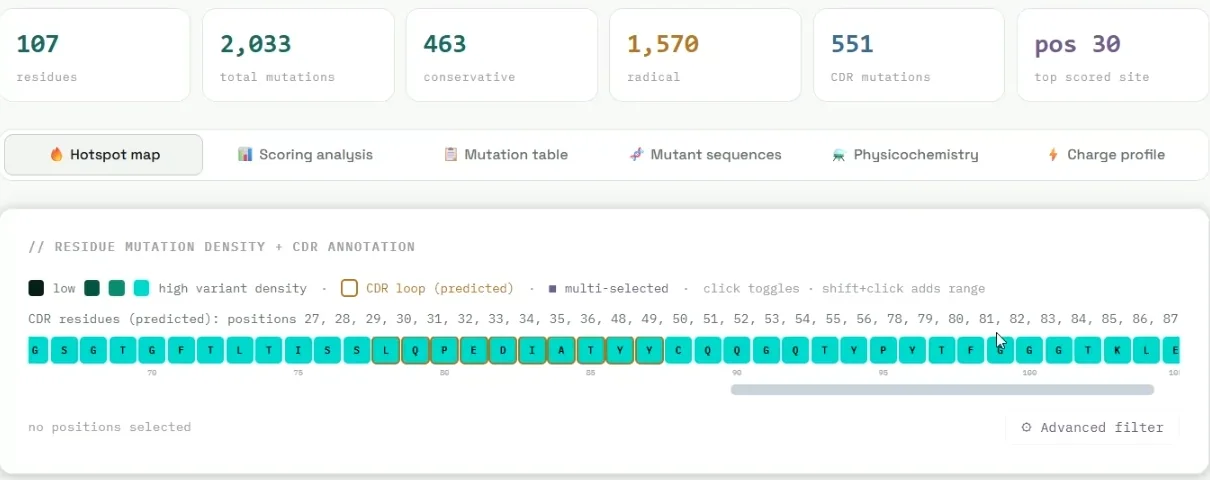
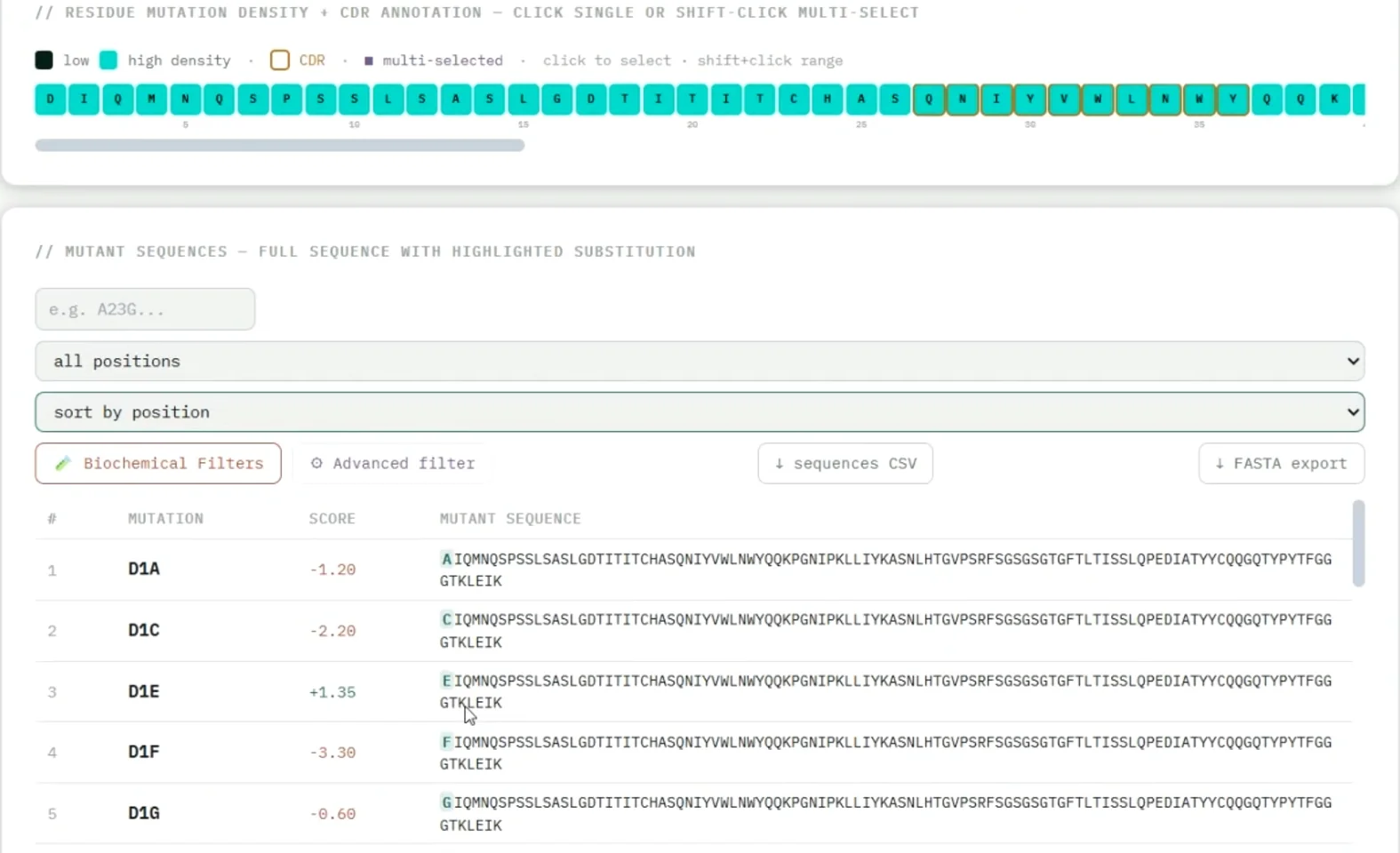
Each residue is coloured by how many variants it has, with predicted CDR loops outlined. Click to select a position, or shift-click for a range.
- Variant density per residue
- Predicted CDR loops
- Single and range selection
CDR regions are estimated with a sequence heuristic, not IMGT or Kabat numbering.
- B · Mutation design
Narrow it down with a position filter
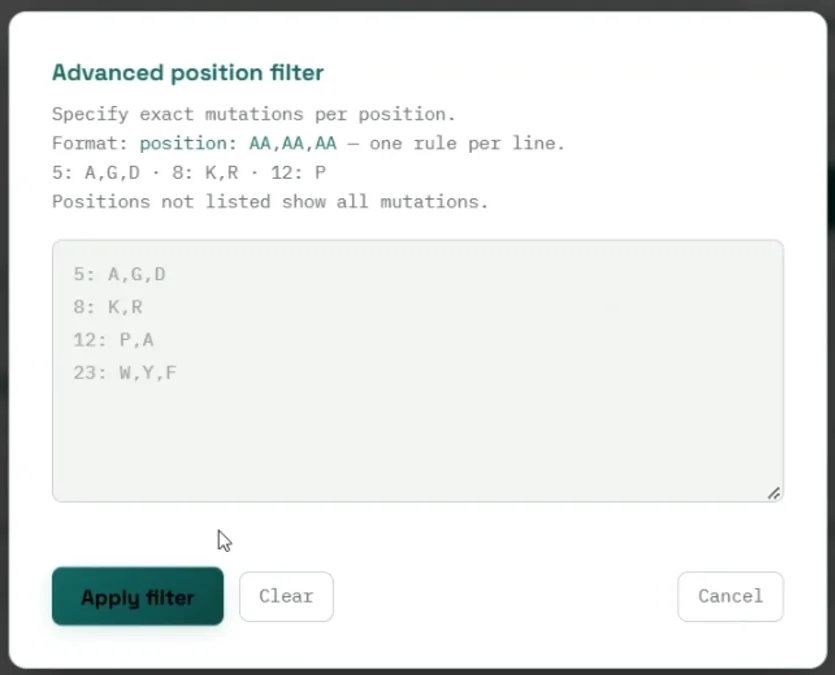
Specify exact substitutions per position, one rule per line. Positions you do not list keep all their mutations.
- Rule format: position: AA,AA,AA
- Applied or cleared in one step
- C · Analysis
Compare scores at a glance
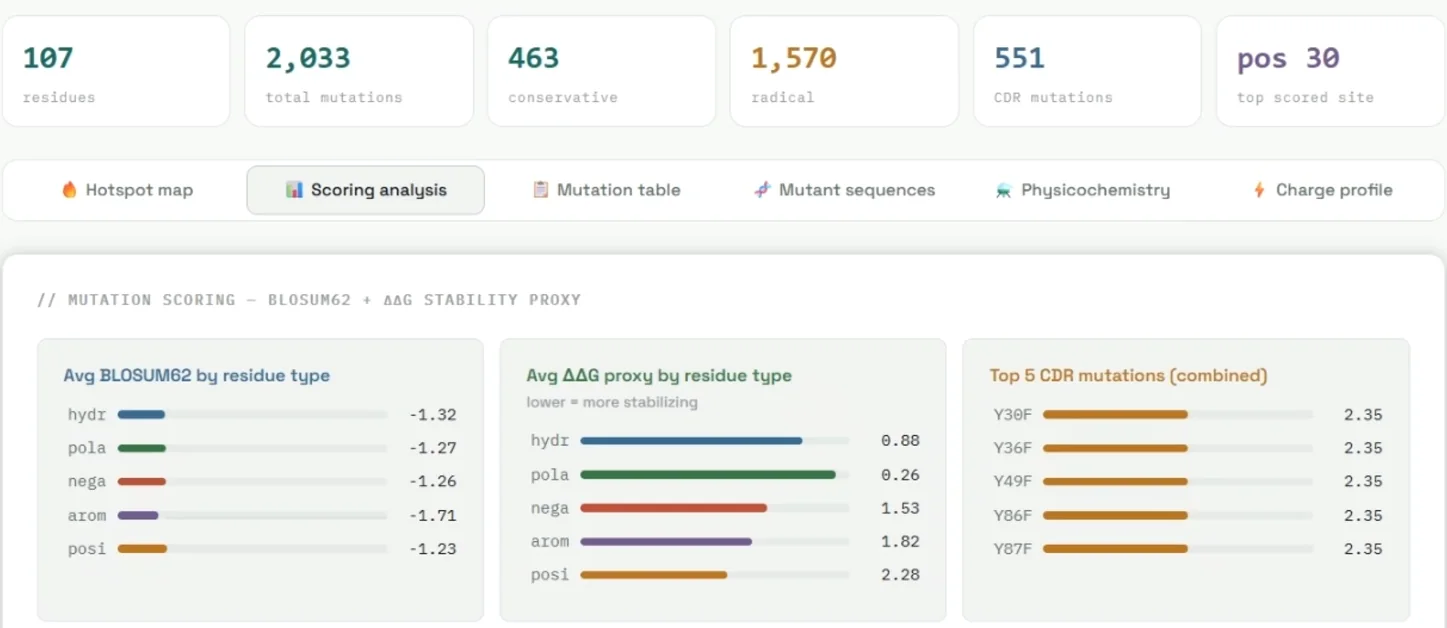
Average BLOSUM62 and ΔΔG proxy by residue type, plus the top CDR mutations ranked by combined score.
- Summary counts for the run
- Scores by residue type
- Top-ranked CDR mutations
Heuristic scores. They rank candidates and do not establish improved binding or stability.
- C · Analysis
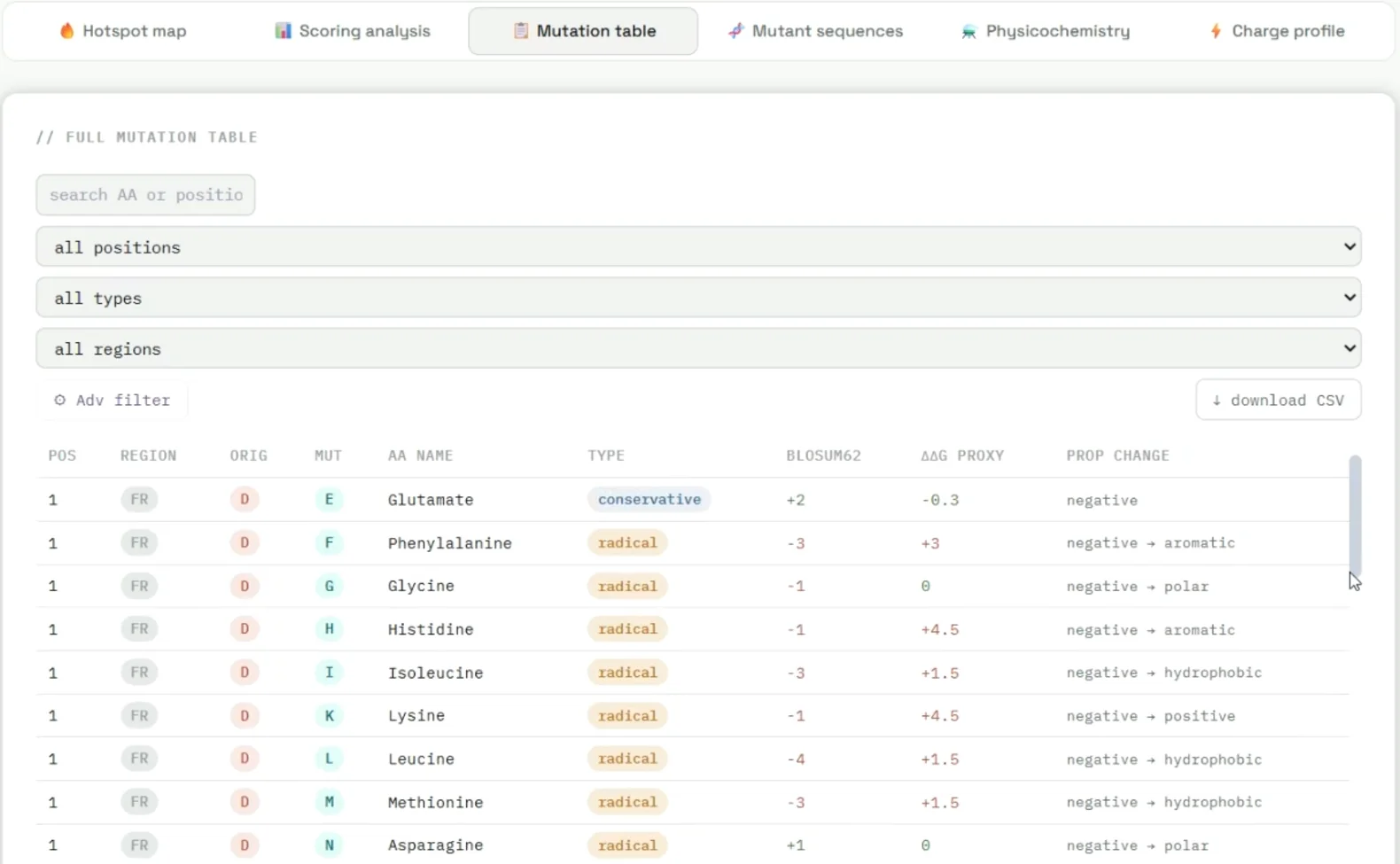
Inspect every candidate
A full mutation table you can search and filter by position, type and region, with a CSV download.
- Position, region, original and mutant residue
- Conservative or radical
- BLOSUM62, ΔΔG proxy and property change
- C · Analysis
Read the mutant sequences
Full sequences with the substitution highlighted, filterable and exportable as CSV or FASTA.
- Substitution highlighted in context
- Sequences CSV and FASTA export
- C · Analysis
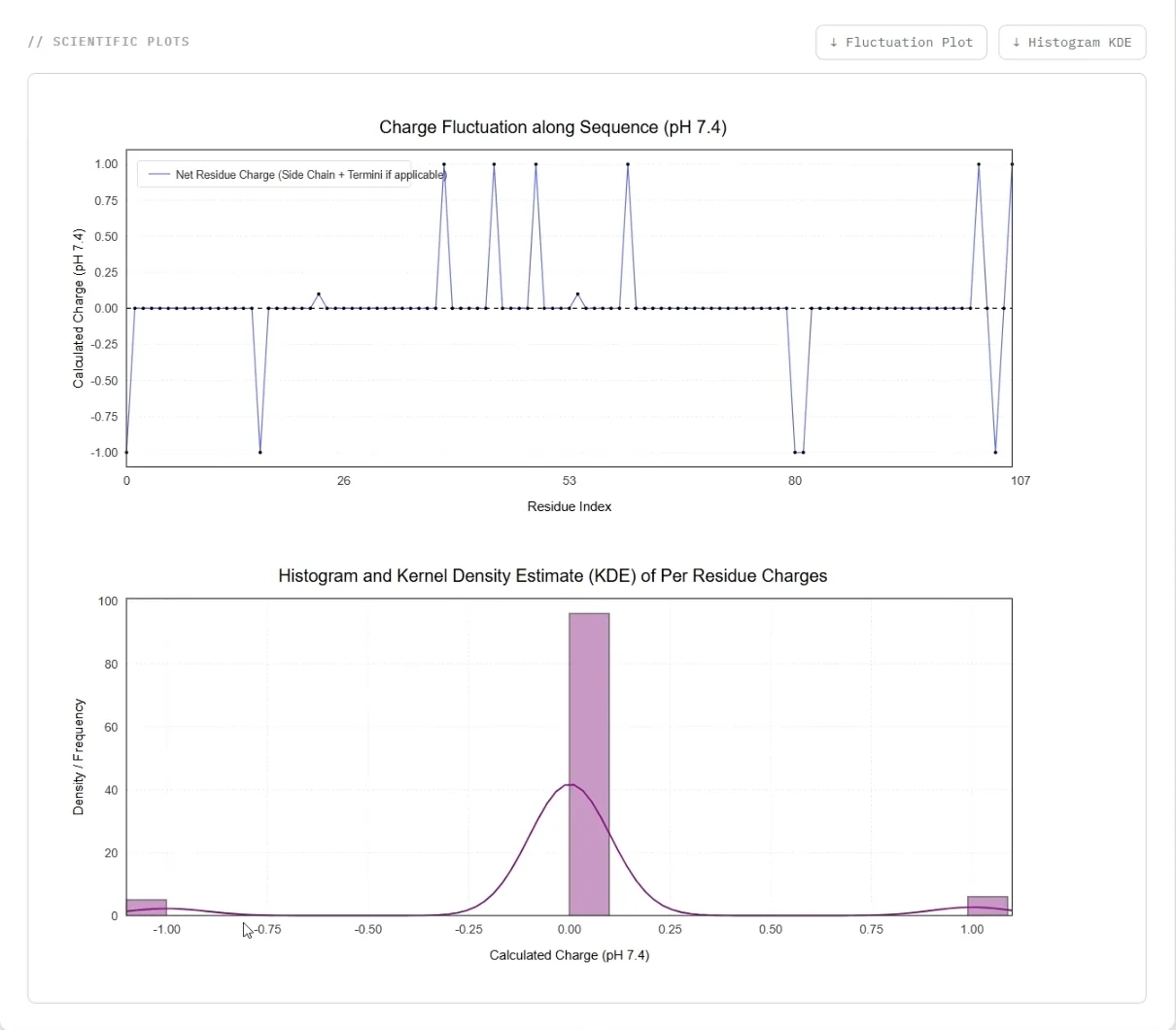
Check charge along the sequence
Per-residue charge at pH 7.4 along the sequence, and a histogram with a kernel density estimate. Both plots can be downloaded.
- Charge fluctuation plot
- Histogram and KDE of residue charges
A shortlist to investigate further
Candidates, scores, sequences and charge plots can be exported as CSV, FASTA and SVG. Scores rank candidates for further computational or experimental evaluation; they do not establish improved binding, stability or activity.
Explore a mutation
Pick a position, then a replacement. Every value is computed live by the same scoring rules.
- Type
- radical
- Property change
- negative → polar
- Δ hydrophobicity
- +3.10
- Δ volume (ų)
- −51.0
Illustrative sequence example. Predicted scores and sequence descriptors do not establish biological benefit.
Turn Sequence Variation into a Research Shortlist
Explore candidate substitutions, compare sequence-level descriptors and organize promising variants for further investigation.